Evan Thompson
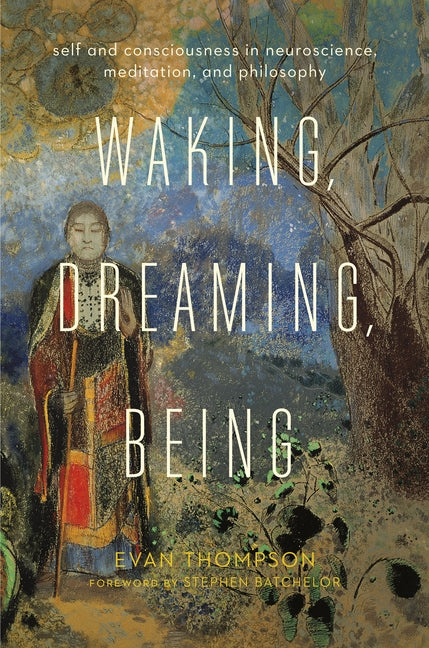
Waking, Dreaming, Being: Self and Consciousness in Neuroscience, Meditation, and Philosophy
Waking, Dreaming, Being: Self and Consciousness in Neuroscience, Meditation, and Philosophy
Couldn't load pickup availability
Evan Thompson's profound synthesis of neuroscience, phenomenology, and Buddhist philosophy—a groundbreaking exploration of consciousness through the states of waking, dreaming, and deep sleep, bridging Western cognitive science with contemplative traditions to reveal how self and consciousness emerge, transform, and dissolve across these fundamental modes of human experience.
Evan Thompson, philosopher and cognitive scientist at the University of British Columbia and co-author of the influential The Embodied Mind, published Waking, Dreaming, Being in 2014 as a comprehensive investigation of consciousness across its primary states. Drawing on cutting-edge neuroscience, phenomenology (particularly Husserl and Merleau-Ponty), and Indian philosophy (especially Yogācāra Buddhism and Advaita Vedānta), Thompson explores how consciousness manifests differently in waking, dreaming, and deep sleep—and what these transformations reveal about the nature of self, awareness, and reality.
What you'll discover:
- The neuroscience of waking consciousness, REM sleep, and deep dreamless sleep
- Phenomenology of dreaming—lucid dreams, dream yoga, and consciousness in sleep
- Buddhist and Vedānta perspectives on consciousness and the witness state
- How the sense of self changes across waking, dreaming, and deep sleep
- The relationship between consciousness and the brain in different states
- Contemplative practices for exploring consciousness: dream yoga, meditation, witnessing
- The "hard problem" of consciousness examined through sleep states
- What deep sleep reveals about consciousness without content
Thompson's central insight is that consciousness is not a single, unchanging phenomenon but transforms radically across waking, dreaming, and deep sleep. In waking, we experience a stable world and embodied self. In dreaming, the world becomes fluid and the self more malleable, yet consciousness remains vivid. In deep sleep, both world and self seem to dissolve—yet some traditions claim a subtle awareness persists even here. By examining these transformations, Thompson illuminates fundamental questions: What is the relationship between consciousness and its contents? Can consciousness exist without an object? What is the self, and does it persist across all states?
What makes this book essential for your contemplative library is its rigorous integration of neuroscience and contemplative wisdom. Thompson doesn't privilege one perspective over the other but brings them into genuine dialogue. He examines what neuroscience reveals about brain activity during sleep states, what phenomenology teaches about the lived experience of consciousness, and what Buddhist and Vedānta traditions have discovered through millennia of contemplative investigation. The result is a comprehensive, multidimensional understanding of consciousness that honors both scientific rigor and contemplative insight.
The book explores lucid dreaming and dream yoga in depth—practices where one becomes aware within the dream state and can investigate the nature of consciousness directly. Thompson examines both Western research on lucid dreaming and Tibetan Buddhist dream yoga practices, showing how these traditions converge on similar insights: that recognizing the dream-like nature of experience can lead to awakening. He also investigates the witness state described in Advaita Vedānta—a pure awareness said to persist even in deep sleep—and examines whether neuroscience and phenomenology support or challenge this claim.
Thompson's approach is enactivist—consciousness is not something that happens in the brain alone but emerges from the dynamic interaction between brain, body, and environment. This perspective, developed in The Embodied Mind, shapes his analysis of sleep states. Dreaming, for example, isn't just brain activity but an embodied simulation of being-in-the-world. Deep sleep isn't mere unconsciousness but a distinct mode of being that may include subtle forms of awareness. This enactivist framework bridges neuroscience and phenomenology, showing how consciousness is both biological and experiential.
The philosophical implications are profound. If consciousness transforms so radically across waking, dreaming, and deep sleep, what does this reveal about its nature? Thompson argues that consciousness is not a fixed entity but a dynamic process, and the self is not a permanent substance but a construction that arises, transforms, and dissolves. This aligns with Buddhist teachings on no-self and impermanence while remaining grounded in neuroscience and phenomenology.
Waking, Dreaming, Being has become essential reading in consciousness studies, contemplative neuroscience, and philosophy of mind. It stands as one of the most comprehensive and rigorous explorations of consciousness available, bridging scientific research and contemplative wisdom to illuminate the mystery of awareness across all its states.
Perfect for: Readers of Evan Thompson and The Embodied Mind, students of consciousness studies and neuroscience, practitioners of meditation and dream yoga, those interested in phenomenology and philosophy of mind, readers of Buddhist philosophy and Advaita Vedānta, students of lucid dreaming and sleep research, contemplative readers seeking rigorous integration of science and wisdom traditions, and anyone interested in the nature of self, consciousness, and the transformations of awareness across waking, dreaming, and deep sleep.
This paperback edition presents Evan Thompson's profound synthesis—a groundbreaking exploration of consciousness that bridges neuroscience, phenomenology, and contemplative wisdom to illuminate the mystery of awareness across all its states.
Share