Adi Shankara
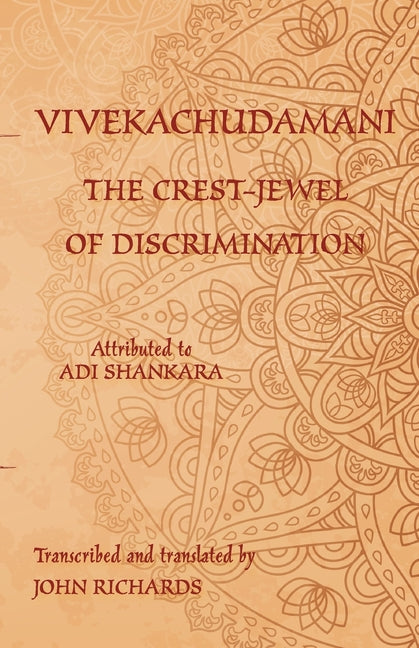
Vivekachudamani - The Crest-Jewel of Discrimination: A bilingual edition in Sanskrit and English
Vivekachudamani - The Crest-Jewel of Discrimination: A bilingual edition in Sanskrit and English
Couldn't load pickup availability
Adi Shankara's Vivekachudamani (The Crest-Jewel of Discrimination)—the most accessible and beloved introduction to Advaita Vedanta philosophy, presenting the path of self-inquiry and non-dual realization through 580 verses that guide seekers from ignorance to the direct recognition of their true nature as pure consciousness (Brahman).
Adi Shankara (788-820 CE), the great philosopher-saint who revitalized Advaita Vedanta and established the non-dual interpretation of the Upanishads, composed Vivekachudamani as a practical manual for spiritual seekers. Written in clear, poetic Sanskrit verses, this text systematically presents the essential teachings of Advaita: the illusory nature of the world (maya), the identity of the individual self (Atman) with ultimate reality (Brahman), and the path of discrimination (viveka) that leads to liberation (moksha). For over twelve centuries, this work has served as the primary introduction to non-dual philosophy for serious students of Vedanta.
What you'll discover:
- The fundamental teaching: 'Tat Tvam Asi' (Thou Art That)—you are Brahman
- Discrimination (viveka) between the real and the unreal, the eternal and the temporary
- The nature of maya (cosmic illusion) and how it veils our true nature
- The three bodies (gross, subtle, causal) and five sheaths that obscure the Self
- Self-inquiry (atma-vichara)—the direct investigation 'Who am I?'
- The qualifications for a spiritual seeker: discrimination, dispassion, six virtues, and longing for liberation
- How to transcend identification with body, mind, and ego
- The nature of pure consciousness—eternal, unchanging, self-luminous
Shankara begins by establishing the qualifications needed for spiritual inquiry: discrimination between the eternal and temporary, dispassion toward worldly pleasures, the six virtues (tranquility, self-control, withdrawal, forbearance, faith, concentration), and intense longing for liberation. He then systematically deconstructs our false identifications—with the physical body, the vital energies, the mind, the intellect, the ego—showing that none of these can be our true Self because they are objects of awareness, while the Self is the eternal witness, pure consciousness itself.
What makes this text essential for your contemplative library is its clarity, systematic presentation, and practical guidance. Shankara doesn't merely assert non-dual philosophy but leads the seeker step-by-step through the process of discrimination and self-inquiry. He explains how ignorance (avidya) creates the illusion of separation, how maya projects the appearance of multiplicity onto the one reality, and how direct knowledge (jnana) of one's true nature as Brahman dissolves all suffering and limitation.
The text employs the method of negation (neti neti—'not this, not this')—systematically eliminating everything that is not the Self until only pure consciousness remains. Shankara shows that you are not the body (which changes and dies), not the mind (which comes and goes), not the intellect (which is an instrument), not even the sense of 'I' (which is a thought). What remains when all false identifications are removed is your true nature—sat-chit-ananda (being-consciousness-bliss), eternal, unchanging, self-luminous awareness.
Shankara's teaching is radically liberating: you are already free, already whole, already the infinite consciousness you seek. Liberation is not achieving something new but recognizing what has always been true. Suffering arises only from the mistaken identification of consciousness with the body-mind, and this mistake is dissolved through discrimination and direct self-knowledge. This is not a gradual path of purification but the immediate recognition of your true nature.
Vivekachudamani has profoundly influenced Hindu philosophy and spirituality, serving as the foundational text for Advaita Vedanta study worldwide. Its teachings resonate with Buddhist emptiness teachings, Zen direct pointing, and contemporary non-dual spirituality. Modern teachers like Ramana Maharshi, Nisargadatta Maharaj, and countless others have drawn on Shankara's method of self-inquiry and discrimination.
This bilingual edition presents the complete Sanskrit text alongside English translation, allowing readers to appreciate the beauty and precision of Shankara's original verses while accessing their meaning through clear translation. Whether you're a student of Vedanta, a practitioner of self-inquiry, or a seeker drawn to non-dual wisdom, this text offers essential guidance on the direct path to self-realization.
Perfect for: Students of Advaita Vedanta and non-dual philosophy, practitioners of self-inquiry and meditation, readers interested in Hindu philosophy and Upanishadic wisdom, those drawn to the teachings of Ramana Maharshi and Nisargadatta Maharaj, students of comparative philosophy exploring non-dualism across traditions, anyone questioning the nature of self and consciousness, serious seekers ready to investigate 'Who am I?', and contemplative readers drawn to the direct recognition of their true nature as pure awareness.
This bilingual paperback edition presents Adi Shankara's complete Vivekachudamani in Sanskrit and English—the essential introduction to Advaita Vedanta that has guided seekers to self-realization for over twelve centuries.
Share