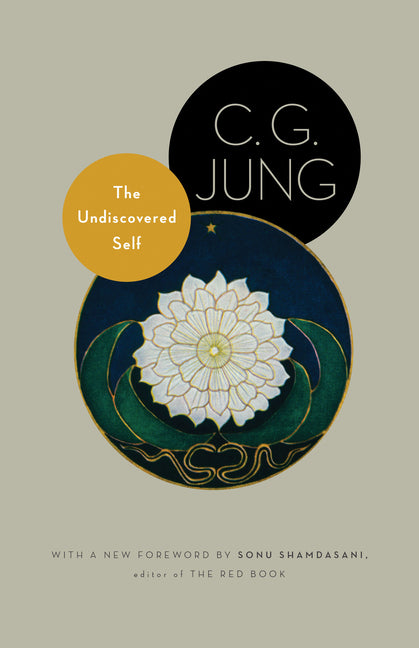
C. G. Jung
The Undiscovered Self: With Symbols and the Interpretation of Dreams
The Undiscovered Self: With Symbols and the Interpretation of Dreams
Couldn't load pickup availability
Carl Jung's profound meditation on the individual in modern society—a penetrating exploration of how mass movements, collective thinking, and state power threaten individual consciousness and spiritual development, paired with his essential essay on symbols and dreams, offering timeless wisdom on preserving authentic selfhood and understanding the language of the unconscious in an age of conformity and mass psychology.
Carl Gustav Jung (1875-1961), the pioneering Swiss psychiatrist and founder of analytical psychology, wrote The Undiscovered Self in 1957 during the Cold War, responding to the rise of totalitarianism, mass movements, and the erosion of individual consciousness in modern society. Jung argues that statistical thinking, collective ideologies, and state power reduce individuals to mere numbers, threatening the development of authentic selfhood and spiritual awareness. Only by discovering and honoring the undiscovered self—the unique, irreducible individual soul—can we resist mass psychology and develop genuine consciousness. This Princeton University Press edition pairs this essential essay with Jung's equally important work on symbols and dream interpretation, creating a comprehensive introduction to Jung's vision of individuation and the unconscious.
What you'll discover:
- Jung's critique of mass society, collective thinking, and the threat to individual consciousness
- The danger of statistical thinking that reduces individuals to averages and types
- How totalitarian movements exploit the unconscious and suppress authentic selfhood
- The role of religion and spiritual development in preserving individual consciousness
- Why self-knowledge is essential resistance to mass psychology
- The process of individuation—becoming who you truly are
- Understanding symbols as the language of the unconscious
- How to approach dreams as messages from the deeper self
In The Undiscovered Self, Jung warns that modern society treats individuals as statistical units rather than unique souls. Mass movements—whether political, religious, or ideological—demand conformity and suppress individual consciousness. The state grows more powerful while the individual becomes weaker, more dependent, and less aware of their own inner life. Jung argues that only through self-knowledge, spiritual development, and honoring the unconscious can individuals resist this collective pressure and develop authentic consciousness. The undiscovered self is the part of us that cannot be reduced to statistics, the unique soul that must be honored and developed.
The companion essay, Symbols and the Interpretation of Dreams, provides practical insight into Jung's approach to the unconscious. Dreams speak in symbols—images that carry meaning beyond literal interpretation. By learning to understand this symbolic language, we can access the wisdom of the unconscious and support the process of individuation. Jung explains how dreams compensate for one-sided conscious attitudes, reveal unconscious contents, and guide psychological and spiritual development.
What makes this book essential for your contemplative library is its vision of individuation as both psychological and spiritual work. Jung sees the development of consciousness not as adjustment to society but as becoming authentically yourself—honoring your unique nature, integrating unconscious contents, and developing relationship with the deeper self. This is contemplative practice in psychological language, a path of self-knowledge that is also spiritual awakening.
Jung's work bridges psychology and spirituality, drawing on Western depth psychology, Eastern philosophy, Christian mysticism, and alchemical symbolism. He respects religious experience while approaching it psychologically, making his work accessible to both believers and seekers outside traditional religion. His emphasis on symbols, dreams, and the unconscious provides practical tools for self-exploration and spiritual development.
This Princeton University Press edition, edited by leading Jung scholar Sonu Shamdasani with the authoritative R.F.C. Hull translation, presents two essential Jung essays in an accessible, affordable format—perfect for readers new to Jung or those seeking his most relevant work on individuation, consciousness, and the modern condition.
Perfect for: Readers of Carl Jung and depth psychology, students of humanistic and transpersonal psychology, those interested in individuation and self-knowledge, readers concerned with mass society and authentic selfhood, anyone interested in dream interpretation and symbolic thinking, students of psychology and spirituality, contemplative readers seeking psychological tools for spiritual development, and seekers interested in the relationship between consciousness, the unconscious, and authentic living.
This Princeton University Press edition presents two essential Jung essays—profound meditations on preserving individual consciousness in mass society and understanding the symbolic language of the unconscious.
Share