Jeffrey M. Schwartz
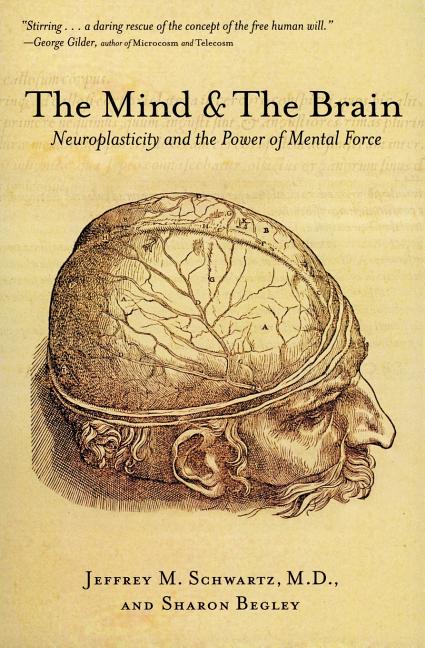
The Mind and the Brain: Neuroplasticity and the Power of Mental Force
The Mind and the Brain: Neuroplasticity and the Power of Mental Force
Couldn't load pickup availability
Jeffrey Schwartz and Sharon Begley's groundbreaking exploration of neuroplasticity and the power of consciousness—a revolutionary synthesis of neuroscience, quantum physics, and Buddhist mindfulness demonstrating how focused mental effort can literally rewire the brain, challenging materialist assumptions about consciousness and revealing the mind's capacity to shape its own neural substrate through directed attention and contemplative practice.
Jeffrey M. Schwartz, a research psychiatrist at UCLA, and science writer Sharon Begley published The Mind and the Brain in 2002, presenting Schwartz's pioneering research on using mindfulness-based therapy to treat obsessive-compulsive disorder (OCD). Through rigorous brain imaging studies, Schwartz demonstrated that patients who used mindful attention to observe and redirect their obsessive thoughts actually changed their brain activity patterns—proving that mental effort, not just medication or physical intervention, can rewire neural circuits. This discovery challenged the prevailing materialist view that the brain creates consciousness and suggested instead that consciousness can actively shape the brain.
What you'll discover:
- Neuroplasticity—the brain's capacity to reorganize and rewire itself throughout life
- How focused mental effort and mindful attention can change brain structure and function
- Schwartz's four-step method for treating OCD through mindfulness and self-directed neuroplasticity
- The relationship between consciousness, attention, and neural activity
- Quantum physics and the role of the observer in shaping reality
- Buddhist mindfulness practices as tools for neuroplasticity
- The philosophical implications: does the brain create mind, or does mind shape brain?
- Evidence challenging strict materialism about consciousness
Schwartz's research began with a simple but profound question: Can people with OCD change their brains through mental effort alone? Using PET scans, he tracked patients who practiced his mindfulness-based four-step method: Relabel (recognize the obsessive thought), Reattribute (understand it's caused by OCD), Refocus (direct attention elsewhere), and Revalue (see the thought as meaningless). The results were stunning—patients who successfully used this method showed measurable changes in brain activity, specifically decreased activity in the orbital frontal cortex, the region associated with OCD. Mental effort had literally rewired their brains.
What makes this book essential for your contemplative library is its bridge between neuroscience and contemplative practice. Schwartz draws explicitly on Buddhist mindfulness—the practice of observing thoughts and sensations without attachment—as the foundation for self-directed neuroplasticity. He argues that mindful attention creates a space between stimulus and response, allowing conscious choice rather than automatic reaction. This space is where mental force operates, where consciousness actively shapes neural patterns rather than passively reflecting them.
The book also ventures into quantum physics, exploring how the observer effect in quantum mechanics might relate to consciousness and free will. Schwartz suggests that consciousness, like the quantum observer, plays an active role in shaping reality—not just passively receiving information but actively participating in what emerges. While this section is more speculative and controversial, it raises profound questions about the relationship between mind, brain, and physical reality.
The philosophical implications are significant. If mental effort can change the brain, then consciousness cannot be reduced to brain activity alone. The mind has causal power—it's not just an epiphenomenon of neural firing but an active force that shapes its own neural substrate. This challenges strict materialism and opens space for understanding consciousness as fundamental rather than derivative.
The Mind and the Brain has influenced both neuroscience and contemplative practice, demonstrating that ancient mindfulness techniques have measurable neurological effects and that consciousness plays an active role in shaping the brain. It stands as essential reading for anyone interested in neuroplasticity, the science of meditation, and the relationship between mind and brain.
Perfect for: Readers interested in neuroscience and consciousness studies, students of neuroplasticity and brain science, practitioners of mindfulness and meditation seeking scientific grounding, those interested in the relationship between mind and brain, readers of contemplative neuroscience and Buddhist psychology, students of quantum physics and consciousness, anyone questioning materialist assumptions about consciousness, and contemplative readers seeking to understand how mental practice shapes the brain.
This paperback edition presents Schwartz and Begley's groundbreaking work—a revolutionary exploration of how consciousness can actively rewire the brain through focused mental effort and contemplative practice.
Share