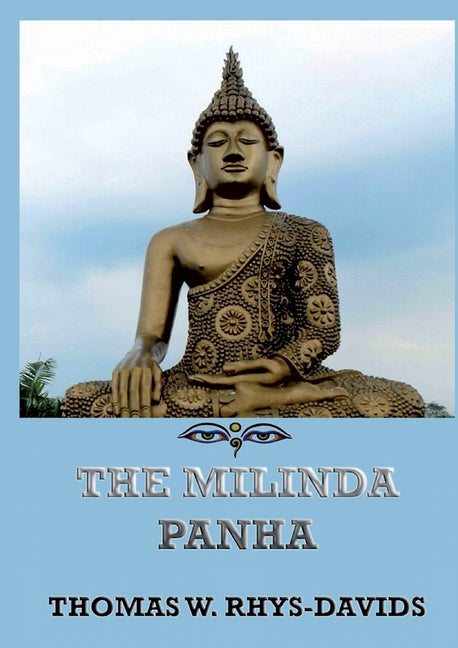
Thomas William Rhys Davids
The Milinda Panha: The Questions of King Milinda: Historically Annotated Edition
The Milinda Panha: The Questions of King Milinda: Historically Annotated Edition
Couldn't load pickup availability
What is the nature of the self, and how do we reconcile Buddhist teachings with reason and experience? The Milinda Panha (The Questions of King Milinda) is one of the most remarkable texts in Buddhist literature—a philosophical dialogue between the Indo-Greek King Menander I (Milinda) and the Buddhist sage Nāgasena that explores the fundamental teachings of Buddhism through rigorous questioning and brilliant reasoning. Composed in Pali around the 1st or 2nd century CE, the text records how a Greek king, trained in Hellenistic philosophy and accompanied by his guard of 500 Greek soldiers, encounters Buddhist doctrine and challenges it with penetrating questions about the self, karma, rebirth, nirvana, and the nature of reality. Through Nāgasena's skillful responses—using analogies, logic, and insight—the king comes to embrace the Buddhist path, demonstrating that the dharma can withstand the most rigorous philosophical scrutiny.
The dialogue unfolds through a series of questions that address the core paradoxes and difficulties of Buddhist teaching. King Milinda asks: If there is no permanent self, who is reborn? How can karma follow from one life to another if there is no continuous identity? What is nirvana, and how can it be described? How do we reconcile the doctrine of non-self with moral responsibility? Nāgasena responds with famous analogies that have become classics of Buddhist philosophy—the chariot that exists as a collection of parts but has no essence beyond them (illustrating non-self), the flame that passes from one candle to another without being the same flame (illustrating rebirth without a permanent soul), the mango that comes from a seed yet is not contained in the seed (illustrating causation without identity). The text demonstrates how Buddhist teachings, though counterintuitive, are logically coherent and experientially verifiable, addressing the concerns of a philosophically sophisticated inquirer.
For contemplative readers, The Milinda Panha offers profound meditation on the nature of self, causation, and the path to liberation through the lens of philosophical dialogue. The work asks: What remains when we let go of the belief in a permanent self? How do we understand continuity and change, identity and transformation? What is the relationship between conventional truth (the self we experience) and ultimate truth (the absence of inherent existence)? How do we reconcile moral responsibility with the teaching of non-self? What is nirvana, and how does it relate to our ordinary experience? How do we use reason and inquiry as tools for spiritual understanding? The text becomes essential reading for anyone seeking to understand Buddhist philosophy through rigorous questioning—offering not dogma but reasoned exploration of the dharma's deepest insights.
What You'll Discover
- Philosophical dialogue between Indo-Greek King Menander and Buddhist sage Nāgasena
- Rigorous questioning of Buddhist teachings on self, karma, rebirth, and nirvana
- Famous analogies: the chariot, the flame, the mango seed
- The doctrine of non-self (anatta) explained through logic and reasoning
- How Buddhist teachings withstand philosophical scrutiny
- The meeting of Greek philosophical tradition and Buddhist wisdom
- T.W. Rhys Davids' classic translation with historical annotations
- Comprehensive analysis of Buddhist origins, doctrines, and development
The Milinda Panha was composed in Pali around the 1st or 2nd century CE, recording dialogues that may have occurred in the 2nd century BCE between the historical Indo-Greek King Menander I (who ruled in what is now Pakistan and northern India) and Buddhist teachers. The text is revered in Theravada Buddhism and has been influential throughout Buddhist Asia for its clear exposition of complex doctrines. Thomas William Rhys Davids (1843–1922) was a pioneering Pali scholar and founder of the Pali Text Society who produced the first complete English translation of this text. This historically annotated edition includes comprehensive analysis of the origins, doctrines, and historical development of Buddhism, providing essential context for understanding this remarkable encounter between Greek and Buddhist thought.
Perfect for: Students of Buddhist philosophy and the doctrine of non-self, readers interested in the dialogue between Eastern and Western philosophical traditions, contemplative practitioners exploring the nature of identity and rebirth, those drawn to philosophical inquiry as a path to understanding, scholars of early Buddhism and Indo-Greek history, anyone seeking rigorous intellectual engagement with Buddhist teachings, readers who appreciate Socratic-style philosophical dialogues.
Paperback edition. A classic Buddhist philosophical dialogue—offering contemplative wisdom on non-self, karma, and nirvana through the rigorous questioning of a Greek king and the brilliant responses of a Buddhist sage.
Share