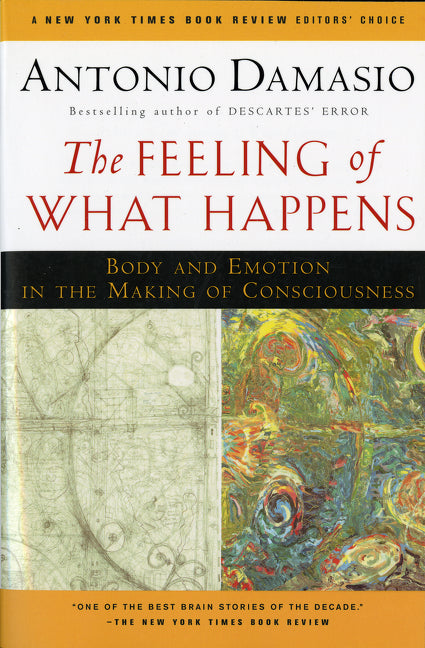
Antonio Damasio
The Feeling of What Happens: Body and Emotion in the Making of Consciousness
The Feeling of What Happens: Body and Emotion in the Making of Consciousness
Couldn't load pickup availability
Antonio Damasio's groundbreaking exploration of consciousness, emotion, and the embodied self—a revolutionary synthesis of neuroscience, philosophy, and clinical observation demonstrating that consciousness emerges from the body's continuous mapping of its own states, that emotion is foundational to reason and selfhood, and that the feeling of what happens in each moment creates the core sense of being alive and aware.
Antonio Damasio, renowned neuroscientist and professor at the University of Southern California, published The Feeling of What Happens in 1999 as a comprehensive theory of how consciousness arises from bodily experience. Drawing on decades of research with brain-damaged patients, neuroimaging studies, and philosophical reflection, Damasio argues that consciousness is not a disembodied phenomenon occurring in the brain alone but emerges from the body's continuous representation of its own emotional and physiological states. The feeling of what happens—the subjective sense of being present in each moment—is the foundation of consciousness and selfhood.
What you'll discover:
- How consciousness emerges from the body's mapping of its own states
- The distinction between core consciousness (moment-to-moment awareness) and extended consciousness (autobiographical self)
- Why emotion is foundational to consciousness, not secondary to reason
- The role of feelings in creating the sense of self
- How brain damage reveals the neural basis of consciousness and emotion
- The somatic marker hypothesis—how bodily feelings guide decision-making
- The proto-self, core self, and autobiographical self as layers of consciousness
- Why consciousness requires both brain and body working together
Damasio's central insight is that consciousness begins with the body. The brain continuously creates maps of the body's internal states—heart rate, breathing, muscle tension, gut sensations—and these bodily maps form the foundation of subjective experience. When something happens—we see a face, hear music, remember an event—the body responds with subtle changes in physiological state. The brain maps these bodily changes, creating feelings. The feeling of what happens in each moment—the subjective sense that something is occurring to me, now—is core consciousness, the most basic form of awareness.
What makes this book essential for your contemplative library is its vision of consciousness as fundamentally embodied and emotional. Damasio challenges the Cartesian separation of mind and body, showing that consciousness doesn't happen in a disembodied brain but emerges from the ongoing dialogue between brain and body. He also challenges the rationalist view that emotion interferes with reason, demonstrating instead that emotion and feeling are essential to rational decision-making, self-awareness, and consciousness itself. Without bodily feelings, there is no sense of self, no subjective experience, no consciousness.
Damasio distinguishes between core consciousness and extended consciousness. Core consciousness is the simple feeling of being here now, aware of something happening. It requires no memory, no language, no autobiographical narrative—just the immediate sense of presence. Extended consciousness builds on this foundation, incorporating memory, language, and the autobiographical self—the story of who we are across time. Both forms of consciousness depend on the body's continuous mapping of its own states and the feelings that arise from these maps.
The book draws on fascinating clinical cases—patients with specific brain damage that disrupts emotion, memory, or self-awareness—to reveal how consciousness is constructed. Damasio shows how damage to certain brain regions can eliminate emotional feeling while leaving cognition intact, or disrupt the sense of self while preserving awareness of the present moment. These cases demonstrate that consciousness is not a single, unified phenomenon but a complex process involving multiple brain systems working together with the body.
Damasio's somatic marker hypothesis—introduced in his earlier work Descartes' Error and developed further here—proposes that bodily feelings mark options as good or bad, guiding decision-making beneath conscious awareness. When we face a choice, our bodies respond with subtle feelings that bias us toward or away from certain options. This embodied guidance is essential to rational decision-making; without it, we become paralyzed by endless deliberation or make choices that harm our wellbeing.
The Feeling of What Happens has become a foundational text in consciousness studies, affective neuroscience, and embodied cognition. It bridges neuroscience and phenomenology, showing how subjective experience emerges from biological processes while honoring the irreducible reality of feelings and consciousness. It stands as one of the most important works on the neuroscience of consciousness and the embodied nature of mind.
Perfect for: Readers interested in neuroscience and consciousness studies, students of embodied cognition and affective neuroscience, those interested in the relationship between emotion and reason, readers of Antonio Damasio and philosophy of mind, students of phenomenology and the body-mind relationship, anyone questioning Cartesian dualism and disembodied views of consciousness, contemplative readers seeking scientific understanding of embodied awareness, and seekers interested in how subjective experience emerges from bodily processes.
This paperback edition presents Antonio Damasio's groundbreaking work—a revolutionary exploration of how consciousness emerges from the body's continuous mapping of its own states and the feeling of what happens in each living moment.
Share