Paul Tillich
Paul Tillich: The Courage to Be
Paul Tillich: The Courage to Be
Couldn't load pickup availability
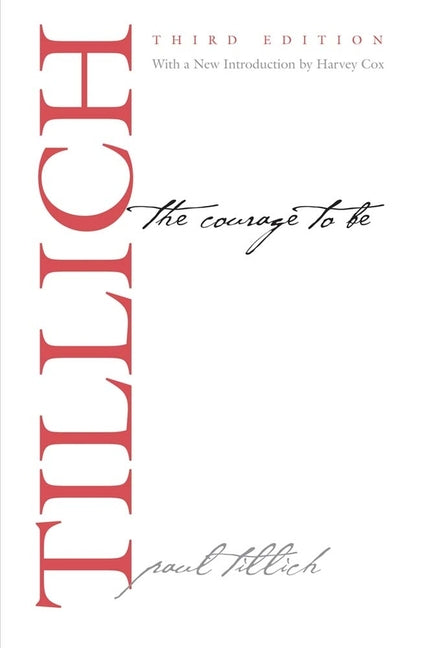
What does it mean to have courage in the face of anxiety—not the courage to conquer external threats, but the courage to affirm your own being despite the ever-present threat of meaninglessness, guilt, and death? Paul Tillich's The Courage to Be is one of the most influential works of 20th-century theology and existential philosophy, a profound meditation on anxiety, faith, and the courage required to exist authentically in a world that offers no ultimate security. Selected as one of the Books of the Century by the New York Public Library, this classic explores how we can face the fundamental anxieties of human existence and discover the courage to be ourselves, grounded in what Tillich calls "the God above God.”
At first glance, anxiety might seem like a psychological problem to be solved. But Tillich reveals something deeper: anxiety is the existential condition of being human, the awareness that we are finite, that we will die, that our lives might be meaningless. He distinguishes three forms of anxiety—the anxiety of fate and death, the anxiety of guilt and condemnation, and the anxiety of emptiness and meaninglessness—and shows how each era of history has been dominated by one of these forms. Yet anxiety is not something to be escaped; it is the price of freedom, the awareness that we must create our own meaning in a world that offers none. The question is not how to eliminate anxiety but how to find the courage to affirm our being in spite of it, to say "yes" to life even when confronted with its ultimate threats.
For readers seeking contemplative wisdom, The Courage to Be offers a profound guide to facing existential anxiety with faith and courage. Tillich doesn't offer easy comfort or simple solutions; he invites us to discover a courage that is not our own achievement but a gift—the courage that comes from participating in the power of being itself, the ground of all existence. This is a book for anyone who has felt the weight of meaninglessness, who has struggled with guilt or the fear of death, who seeks a faith that can sustain them in the face of life's deepest uncertainties. It's a reminder that courage is not the absence of anxiety but the willingness to affirm your being despite it, and that true faith is found not in certainty but in the courage to trust the ground of being even when all else fails.
What You'll Discover
Paul Tillich's masterpiece of Christian existentialism and theological philosophy
Three forms of existential anxiety: fate and death, guilt and condemnation, emptiness and meaninglessness
The courage to affirm your being in the face of ultimate threats
Exploration of faith as courage and participation in the power of being
Selected as one of the Books of the Century by the New York Public Library
Profound questions on anxiety, meaning, and the ground of existence
Paul Tillich (1886-1965) was a German-American theologian and philosopher who became one of the most influential Christian thinkers of the 20th century. Fleeing Nazi Germany in 1933, Tillich taught at Union Theological Seminary, Harvard, and the University of Chicago, where he developed a theology that engaged deeply with existential philosophy, depth psychology, and the challenges of modern secular culture. His work bridges Christian theology and existential thought, exploring themes of anxiety, courage, faith, and the search for ultimate meaning. The Courage to Be, originally published in 1952, is his most accessible and widely read work, offering a vision of faith as the courage to affirm being in the face of non-being, grounded in what he calls "the God above God"—the ground of being itself.
Perfect for: Readers seeking contemplative wisdom on anxiety and courage, students of Christian existentialism and theological philosophy, those struggling with meaninglessness or existential anxiety, anyone interested in faith as courage rather than certainty, readers drawn to Tillich, Kierkegaard, and existential theology, admirers of philosophical theology and depth psychology, seekers navigating the relationship between faith and doubt, students of 20th-century religious thought, those interested in the intersection of theology and existentialism.
Yale University Press edition with new introduction by Harvey Cox. Tillich's existential and theological masterpiece—offering a profound meditation on anxiety, courage, and the faith that affirms being in the face of non-being.
Share