Vine Deloria Jr
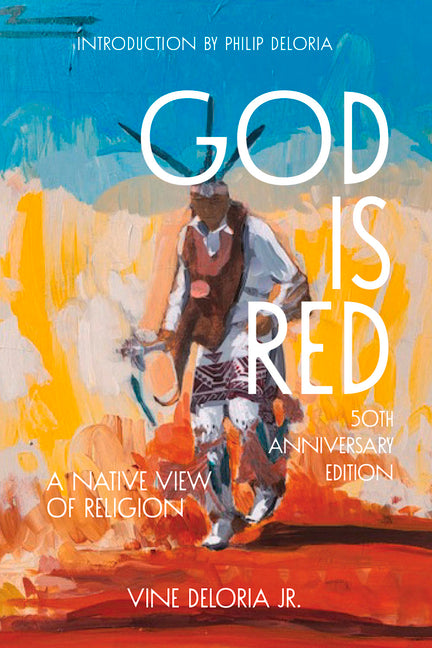
God Is Red: A Native View of Religion
God Is Red: A Native View of Religion
Couldn't load pickup availability
Vine Deloria Jr.'s God Is Red: A Native View of Religion—a groundbreaking work of Indigenous philosophy presenting Native American spiritual worldviews and challenging Western religious assumptions about time, space, creation, and humanity's relationship with the natural world, establishing a powerful critique of Christianity's impact on Indigenous peoples and offering an alternative vision rooted in place, relationship, and sacred presence.
Vine Deloria Jr. (1933-2005), Standing Rock Sioux scholar, theologian, and activist, published God Is Red in 1973 as both a defense of Native American spirituality and a philosophical critique of Western religion. Writing during the Red Power movement, Deloria contrasts Indigenous and Christian worldviews: where Christianity emphasizes linear time, historical revelation, and human dominion over nature, Indigenous traditions emphasize cyclical time, spatial sacredness, and reciprocal relationship with all beings. His work profoundly influenced Native American studies, comparative religion, and environmental philosophy.
What you'll discover:
- Time vs. space—Indigenous religions rooted in sacred places rather than historical events
- Relationship with land—nature as kin and teacher, not resource to dominate
- Cyclical vs. linear time—seasonal renewal versus progressive history
- Community and kinship—extending personhood to animals, plants, and landscape
- Critique of Christianity's impact on Indigenous peoples and lands
- Indigenous concepts of creation, prophecy, and religious experience
- The compatibility of Indigenous spirituality with modern science
- Why place-based spirituality offers wisdom for ecological crisis
Deloria's central argument is that Indigenous religions are fundamentally spatial while Western religions are temporal. Christianity centers on historical events (Exodus, Crucifixion) and linear progress toward salvation. Indigenous traditions center on sacred places (mountains, rivers, ancestral lands) and cyclical participation in seasonal renewal. This difference shapes everything: Indigenous peoples see themselves as part of nature's web of relationships, while Christianity positions humans above nature with dominion over it. Deloria argues that Indigenous worldviews offer profound ecological wisdom desperately needed in our environmental crisis.
What makes God Is Red essential is its philosophical depth and contemporary relevance. Deloria writes not as an anthropologist studying "primitive religion" but as an Indigenous intellectual articulating sophisticated philosophical alternatives to Western assumptions. His critique of Christianity is sharp yet fair, his defense of Indigenous spirituality is rigorous yet accessible. The book profoundly influenced environmental ethics, ecofeminism, liberation theology, and contemporary discussions of religion, ecology, and Indigenous rights.
Perfect for: Students of Indigenous philosophy and Native American spirituality, readers interested in comparative religion and worldviews, those exploring environmental ethics and ecological wisdom, students of the relationship between religion and land, readers seeking alternatives to Western religious frameworks, anyone interested in Indigenous perspectives on creation, time, and sacred presence, and contemplative readers drawn to place-based spirituality and reciprocal relationship with the natural world.
This paperback edition presents Deloria's complete God Is Red—the foundational text of Indigenous religious philosophy that challenges Western assumptions and offers profound wisdom for living in sacred relationship with land and all beings.
Share